


Cornell University Study Confirms 3I/ATLAS Data

A new paper submitted to arXiv through Cornell University on November 24, 2025 is changing how researchers understand the interstellar visitor 3I/ATLAS. According to the study authored by Josep Trigo-Rodríguez, Maria Gritsevich, and Jürgen Blum, the object may possess high tensile strength and a substantial metal fraction, setting it apart from typical comets observed in our solar system.
The research team compared spectral data from 3I/ATLAS to pristine carbonaceous chondrites from NASA’s Antarctic meteorite collection. Carbonaceous chondrites are among the oldest and most primitive materials in our solar system, containing carbon compounds and sometimes water. The spectral similarities indicate that 3I/ATLAS may be a primitive carbonaceous object enriched in native metal. According to the researchers, the combination of elevated metal abundance and abundant water ice can account for the unusual coma morphology and chemical products observed. When fine-grained metal particles come into contact with water, energetic chemical reactions produce specific compounds not commonly seen in other comets. The study suggests this occurs because most comets formed in the outer solar system did not inherit significant metal content.
Independent observations are supporting these findings. Amateur astronomer Ray from Ray’s Astrophotography has been analyzing the core using planetary processing techniques, the same methods used to sharpen images of Saturn and Mars. His data confirms the core is unusually bright rather than dark. This is notable because typical cometary nuclei have reflectivity values of around 4 percent, absorbing light rather than reflecting it. If the Cornell research about metal content is accurate, that could explain the unusual brightness since metal reflects light.

According to observations published by SpaceTracker on December 2, 2025, captured by Chuck’s Astrophotography and processed by Ammar A., the coma appears thicker, more isotropic, and slightly expanded compared to late November. The team noted that 3I/ATLAS displays subtle forward jets indicating sublimation pockets on its rotating nucleus. The coma profile differs from normal long-period comets, behaving more like what researchers call a hyper-volatile body.
Reference to NASA data reveals additional context that was absent from official briefings. The PUNCH mission satellites, launched in March 2025 by SpaceX for the Southwest Research Institute, captured images showing 3I/ATLAS and Mars together in frame during the Mars conjunction. According to NASA, this marked the first time solar-focused missions deliberately observed an interstellar object.
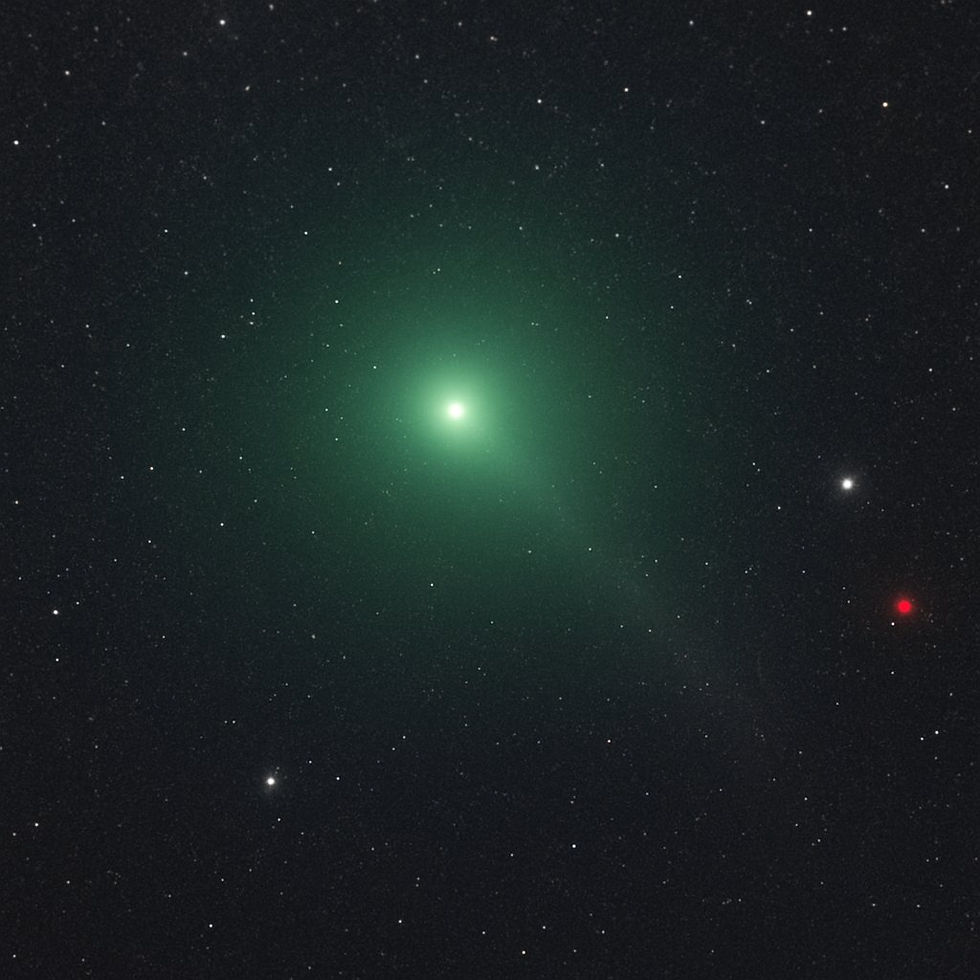
A separate analysis published on Medium by astrophysicist Avi Loeb offers another explanation for the unusual anti-tail structure. According to JPL Horizons data, a non-gravitational acceleration is acting on 3I/ATLAS, pushing the object slightly away from the sun. The theory proposes that if smaller objects surround the main body but do not share this push, they would drift closer to the sun over time. Calculations suggest these objects would drift approximately 54,000 kilometers closer to the sun than the main body, matching the sunward glow astronomers are currently observing. According to analysis of Hubble Space Telescope images taken on July 21, 2025, the light ratio is consistent with what would be expected if a swarm of objects were reflecting sunlight.
3I/ATLAS will reach its closest approach to Earth on December 19, 2025, remaining far enough to pose no threat but close enough for ground-based telescopes to capture detailed observations before it continues toward Jupiter.
Sources
Ammar [@Ammar1176708]. (2025, December 3). [Image of Mars and 3I/ATLAS] https://x.com/Ammar1176708/status/1996021952423526872
Is the Sunward Anti-Tail of 3I/ATLAS Composed of a Swarm of Objects? (2025, November 2). Medium. https://medium.com/@avi-loeb/is-the-sunward-anti-tail-of-3i-atlas-composed-of-a-swarm-of-objects-55c3c75a8e9b
Ray’s Astrophotography. (2025, December 2). Comet 3I ATLAS — What NASA Didn’t Tell Us — I took a PICTURE [Video]. YouTube. https://www.youtube.com/watch?v=RiwOpsshvEg
Space and Technology [@spaceandtech_]. (2025, December 2). NASA’s PUNCH mission captured Mars and 3I/ATLAS together, and what surprised scientists was its brightness. [Image attached] https://x.com/spaceandtech_/status/1995906353458807241
Trigo-Rodríguez, J. M., Gritsevich, M., & Blum, J. (2025, November 24). Spectrophotometric evidence for a metal-bearing, carbonaceous, and pristine interstellar comet 3I/ATLAS. arXiv.org. https://arxiv.org/abs/2511.19112


Comments