


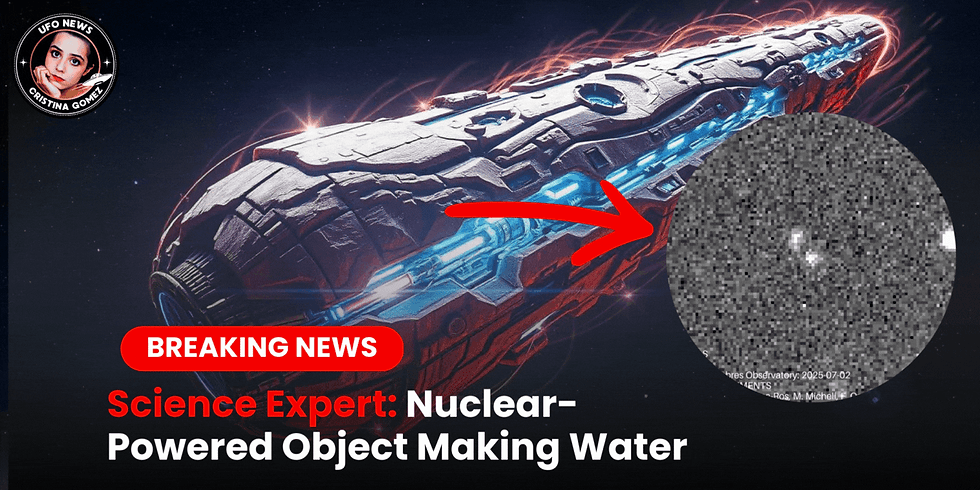
3I/ATLAS Is Nuclear Alien Craft - Says Scientist

The third confirmed interstellar object to enter our solar system continues to baffle scientists with unprecedented characteristics that challenge conventional understanding of cosmic visitors. Discovered on July 1st, 2025, by NASA’s ATLAS telescope system in Chile, the object designated 3I/ATLAS has become the most controversial space phenomenon of the year, with some researchers suggesting it could represent alien technology.
According to NASA’s classification system, 3I/ATLAS holds the record for the most extreme hyperbolic trajectory ever recorded, with an orbital eccentricity of 6.141 that far exceeds its predecessors ‘Oumuamua (1.2) and Borisov (3.4). Traveling at 130,000 mph, the object moves so fast that our sun’s gravity cannot capture it, yet its path through our solar system has raised significant questions about its origins and nature.
Groundbreaking Water Detection
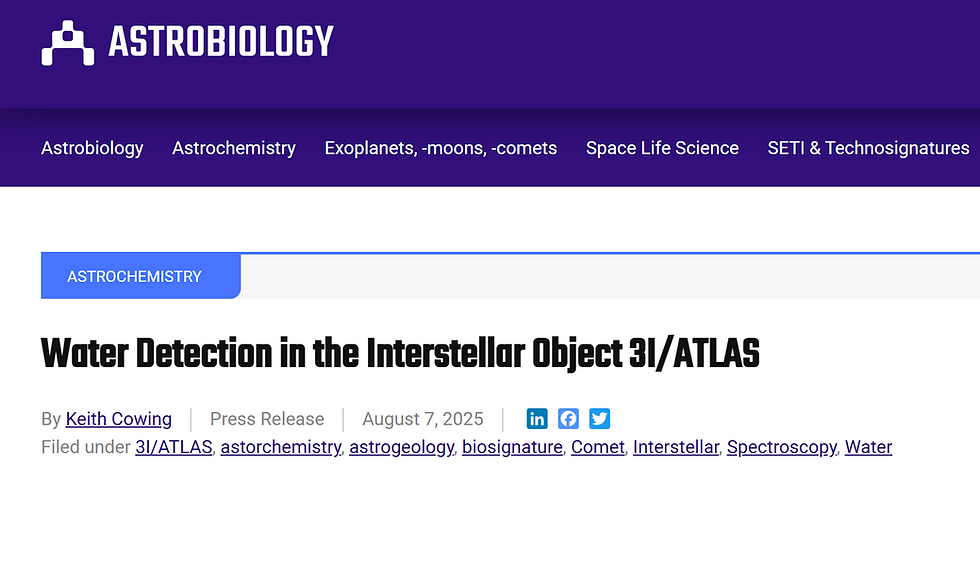
A major breakthrough came through research published by Keith Cowing on August 7th, 2025, revealing that scientists using NASA’s SWIFT Observatory detected active water production in 3I/ATLAS at 3.51 astronomical units from the Sun. According to the findings, the object produces 40 kilograms of water per second, placing it among the rare few comets showing activity beyond three astronomical units, where water ice sublimation typically becomes inefficient.
NASA’s SWIFT Observatory data shows that over 20% of 3I/ATLAS’s surface is actively releasing material — much higher than typical comets. Even stranger, when scientists analyze its light, they’re only detecting water vapor signals without the carbon-nitrogen gases that should be there alongside it. This is like expecting to smell both coffee and bacon when someone’s cooking breakfast, but only detecting the coffee. This missing chemical signature suggests 3I/ATLAS is made of fundamentally different materials than normal comets, supporting theories that it could be something other than a typical space rock.
The Nuclear Spacecraft Theory
Harvard astrophysicist Avi Loeb has proposed the most controversial explanation for 3I/ATLAS’s anomalous behavior. According to Loeb’s recent analysis, if the observed light comes from reflection of sunlight, the object would need to be larger than Manhattan Island, approximately 20 kilometers across. However, Loeb argues there isn’t enough rocky material in interstellar space to deliver such a massive object naturally.
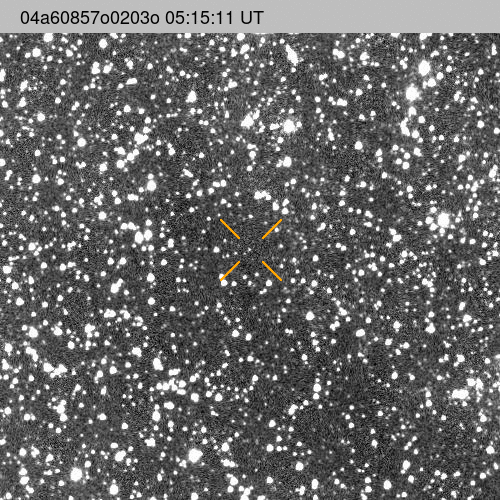
Loeb’s trajectory analysis reveals statistically improbable characteristics that have captured scientific attention. According to his calculations, the object’s path has a probability of less than 0.2% of occurring naturally, with perfect timing to pass close to multiple planets at odds of one in 20,000. Loeb suggests the trajectory could facilitate a “clandestine reverse solar Oberth maneuver,” potentially allowing a spacecraft to use the sun’s gravity to brake and remain bound to our solar system.
Solar Activity Correlations
Geophysicist Stefan Burns has documented compelling correlations between 3I/ATLAS’s approach and increased solar activity. According to Burns’ observations, massive solar eruptions occurred on August 20th, 2025, in the direction of both 3I/ATLAS and Mars. Burns had predicted these electromagnetic disruptions weeks before they occurred, suggesting the interstellar visitor may be triggering unprecedented solar system effects.

Reference to Burns’ analysis indicates that as 3I/ATLAS becomes more ionized and plasmified during its approach, it may be contributing to or triggering solar outburst events. Burns predicts continued increased solar activity as the object approaches its October 29th perihelion, with potential Earth impacts from associated coronal mass ejections around Halloween.
Scientific Observations and Implications
The Hubble Space Telescope captured images on July 21st, 2025, revealing a teardrop-shaped cloud of dust with streams pointing away from the sun, indicating clear cometary activity at 3.8 astronomical units. According to NASA’s David Jewitt, who led the Hubble analysis, tracking the object is “like glimpsing a rifle bullet for a thousandth of a second,” emphasizing the extraordinary nature of capturing detailed images of something moving at such extreme speeds.

ESA scientists have contributed significant observational data, confirming that 3I/ATLAS is approximately 670 million kilometers from the Sun and will make its closest approach in late October 2025, passing just inside Mars’s orbit. According to ESA’s safety assessment, the object poses no threat to Earth, maintaining a safe distance of over 240 million kilometers.
As 3I/ATLAS approaches its closest point to the Sun, scientists worldwide are preparing for intensive observation campaigns. The object will disappear behind the Sun in late October but should reappear for renewed observations by early December 2025. According to current research plans, data from JWST observations and Mars reconnaissance missions may provide definitive answers about the object’s true nature.
The combination of water activity at unusual distances, statistically improbable trajectory, and potential solar system effects makes 3I/ATLAS one of the most scientifically significant objects ever observed. Whether it proves to be an ancient comet from another star system or something more extraordinary, 3I/ATLAS has already expanded our understanding of what’s possible in the cosmos and challenged our assumptions about interstellar visitors.
Sources
Cowing, K. (2025a, August 7). Water detection in the interstellar object 3I/ATLAS — Astrobiology. Astrobiology. https://astrobiology.com/2025/08/water-detection-in-the-interstellar-object-3i-atlas.html
Cowing, K. (2025b, August 13). Simultaneous visible spectrophotometry of interstellar object 3I/ATLAS with SEIMEI/TRICCS — Astrobiology. Astrobiology. https://astrobiology.com/2025/08/simultaneous-visible-spectrophotometry-of-interstellar-object-3i-atlas-with-seimei-triccs.html
European Space Agency. (n.d.). ESA tracks rare interstellar comet. Retrieved August 21, 2025, from https://www.esa.int/Space_Safety/Planetary_Defence/ESA_tracks_rare_interstellar_comet
information@eso.org. (n.d.). Hubble makes size estimate of interstellar comet. www.esahubble.org. https://esahubble.org/news/heic2509/
Loeb, A. (n.d.). Security risks from interstellar objects. Medium. Retrieved August 21, 2025, from https://avi-loeb.medium.com/security-risks-from-interstellar-objects-6f168b936e41
NewsNation. (2025, August 21). 3I/ATLAS may be nuclear-powered, says scientist studying hurtling object | Elizabeth Vargas Reports [Video]. YouTube. https://www.youtube.com/watch?v=swRKXOeNs_Q
Stefan Burns. (2025, August 20). It’s Already Happening! The Sun Begins Interacting with 3I/ATLAS as Cosmic Frequencies Increase 🌌 [Video]. YouTube. https://www.youtube.com/watch?v=_iEVkm_QdKQ
Wasser, M., & Wasser, M. (2025, August 7). Comet 3I/ATLAS — NASA Science. NASA Science. https://science.nasa.gov/solar-system/comets/3i-atlas/
WorldCam. (2025, August 11). 🌎 LIVE Tracking 3I/ATLAS: Alien Probe or interstellar Comet? [Video]. YouTube. https://www.youtube.com/watch?v=-qI3f07rt1s


Comments